Please note: this article was published on 31 March 2026 for the 2025/26 tax year. Tax rates and rules may have changed since, so please contact us for up-to-date advice.

The tax year ends on 5 April.
Most business owners focus heavily on what must be done before that date, pensions, dividends, allowances.
But once 6 April arrives, something far more important happens:
You get a clean slate.
New allowances.
New thresholds.
A fresh planning window.
The businesses that grow consistently don’t just react at year end. They plan from day one of the new tax year.
Here’s what smart planning for 2026/27 looks like.
1️⃣ Your Allowances Reset 💷
From 6 April:
- Your personal allowance resets
- Your ISA allowance resets
- Your pension annual allowance resets
- Dividend allowances reset
- Capital Gains Tax annual exemption (if applicable) resets
This is an opportunity.
Rather than waiting until next March, early-year planning allows you to:
- Structure income efficiently across the full year
- Avoid drifting into higher-rate tax unexpectedly
- Plan extraction quarterly rather than reactively
Planning in April is calmer and more strategic than planning in March.
2️⃣ Directors: Set a Remuneration Strategy Early 💼
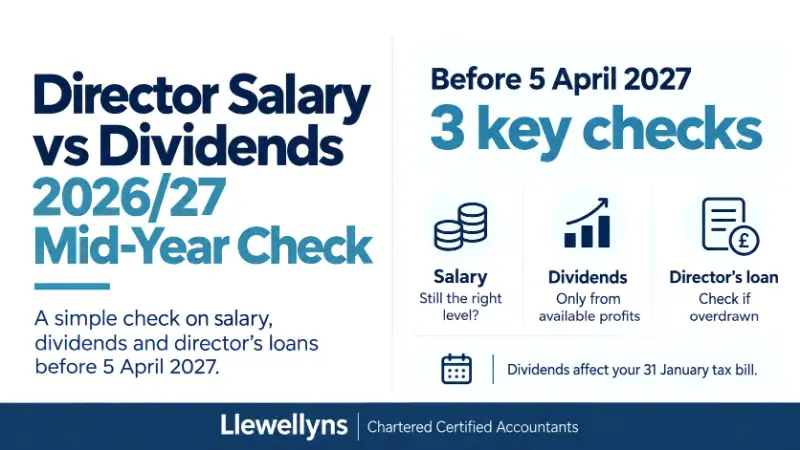
If you run a limited company, 6 April is the time to decide:
- What will your salary be for the year?
- What is your dividend strategy?
- What profit level are you targeting?
- How much do you want to retain in the company?
Too many directors take money randomly throughout the year, then try to “fix it” at year end.
A structured plan from April means:
- Fewer surprises
- Better cashflow control
- Clear tax projections
- Reduced stress in January
3️⃣ Forecast Corporation Tax Now 📈
If your company year aligns with the tax year, April is the perfect time to forecast:
- Expected turnover
- Expected profit
- Corporation Tax liability
- Quarterly dividend capacity
If your year end differs, this is still a good point to reforecast.
Forward planning allows you to:
- Adjust pricing if margins are tight
- Control expenditure
- Decide whether pension contributions should form part of your strategy
Corporation Tax should never be a surprise.
4️⃣ Sole Traders: Review Structure Early 👤
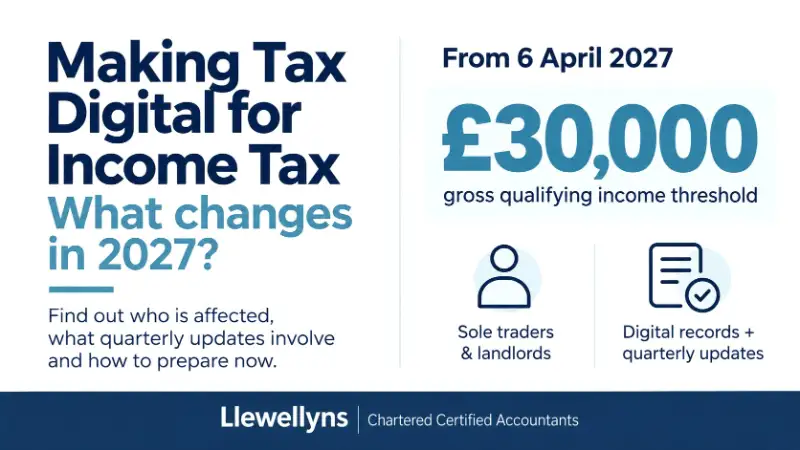
With Making Tax Digital for Income Tax applying to many sole traders, April is a natural checkpoint.
Ask:
- Are profits increasing?
- Am I close to higher-rate tax?
- Is remaining a sole trader still efficient?
- Should incorporation be reviewed this year?
Structure decisions are more powerful when made early, not after profits are locked in.
5️⃣ Quarterly Planning > Annual Panic 🔄
The businesses that stay in control treat tax planning as a quarterly exercise.
From April onward, consider:
- Reviewing management accounts quarterly
- Projecting profit every 3 months
- Checking tax exposure regularly
- Adjusting dividends based on real numbers
This avoids the common cycle of:
Busy year → unclear profit → January shock.
6️⃣ Cashflow Planning for 2026/27 💰
April is also the time to map:
- VAT payments
- Corporation Tax due dates
- Self Assessment payments on account
- Loan repayments
- Pension commitments
Mapping these early gives you visibility.
Cashflow pressure rarely comes from tax rates, it comes from poor timing awareness.
7️⃣ Investment & Growth Decisions 🚀
A new tax year is an opportunity to ask bigger questions:
- Are you planning to hire?
- Invest in equipment?
- Expand premises?
- Increase marketing?
- Review pricing?
Tax planning should support growth, not restrict it.
When profits are forecast properly, decisions become intentional.
8️⃣ Making Tax Digital – Prepare Early 📅
If you fall within the scope of MTD for Income Tax, or expect to soon, April is when digital systems should already be in place.
Quarterly reporting changes behaviour.
Businesses that adopt structured bookkeeping early:
- Understand profitability faster
- Spot issues sooner
- Make better decisions
Digital compliance can become a strategic advantage if handled correctly.
9️⃣ Avoid the “Drift Year” 📌
Many businesses drift between April and December.
No forecasting.
No structured extraction.
No review until January.
That’s where inefficiency creeps in.
Planning for 2026/27 now means:
- Clear targets
- Clear extraction strategy
- Clear tax visibility
- Clear growth direction
Final Thought
5 April isn’t the end of planning.
It’s the start of the next cycle.
The most successful business owners don’t wait for problems — they design the year intentionally.
If you would like to start 2026/27 with a structured plan covering remuneration, profit forecasts, tax exposure and cashflow, we’re happy to review your position.
The earlier the strategy is set, the more control you have.
Talk to Llewellyns
Every situation is different. If you'd like advice on how this affects you or your business, get in touch with our Cardiff or Tonypandy office.